
5 interesting things for your week (#4)
Base plate details; Madrid's efficient metro construction; Bell Labs and more

1. What’s the deal with base plates?
Just watch this 12 minute video on base plates and thank me later.
2. Madrid tripled the length of its metro in 12 years
This is a fascinating story of how the city of Madrid almost tripled the length of its metro network in the 12 years from 1995 to 2007.
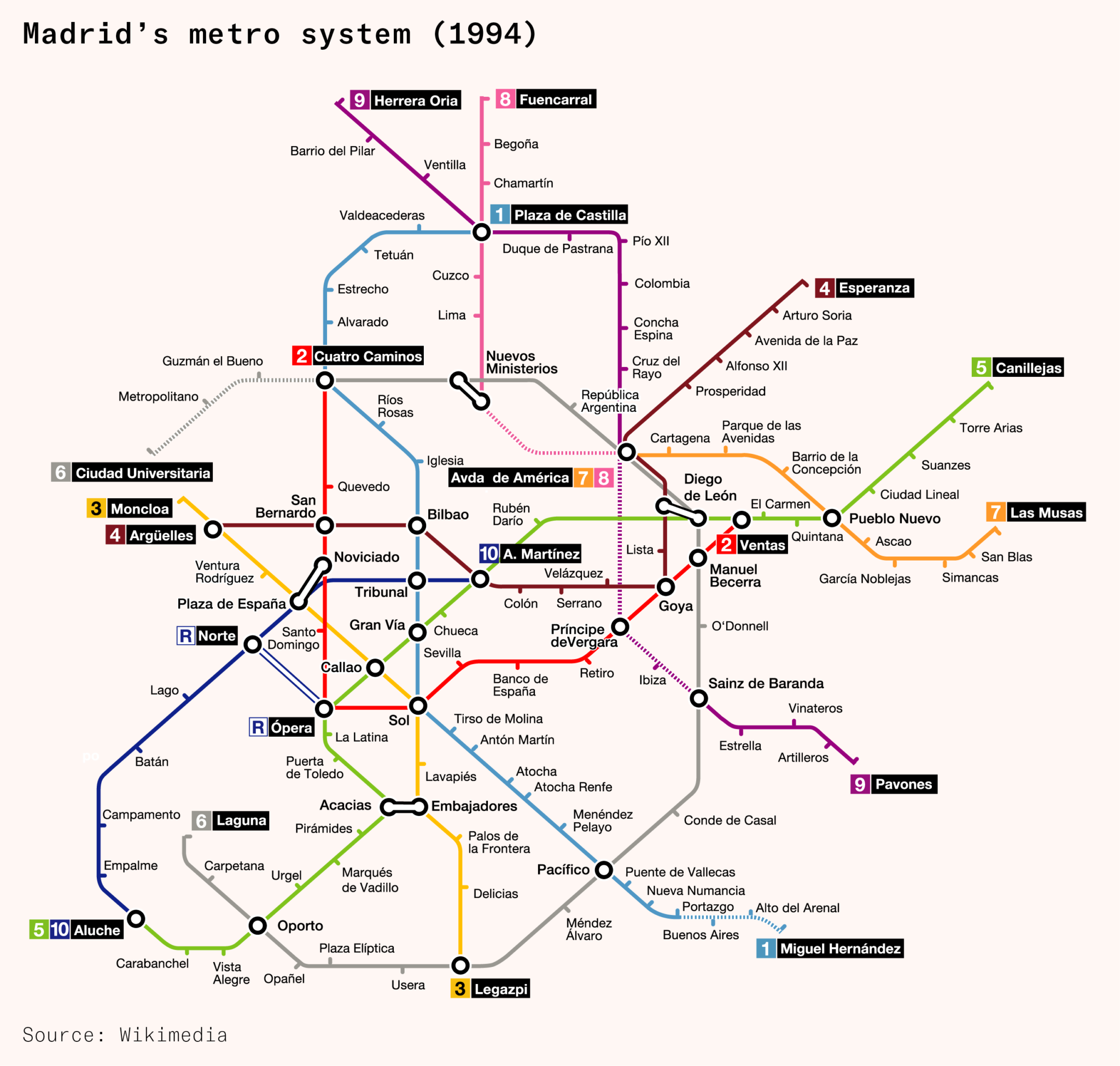

The painfully obvious answer to “how did they do it” is that they spent less money. But how did they do that when other metro lines in New York and London were spending 10x the amount?
That’s where the lessons lie.
City-level powers rewarded fast, inexpensive delivery. The structure of the Community of Madrid concentrated the planning, funding, and construction powers at the right level to deliver the project. This enabled political entrepreneurs to make electoral promises about delivering new infrastructure and have their political fortunes dependent on success.
The projects were delivered at a hyper-local level which allowed the movers and shakers to have skin in the game.
Time is money. The regional government streamlined environmental and planning processes and the company that oversaw construction expedited the building by tunneling 24/7.
We could definitely do with more of this. Environmental and planning processes and red tape in general come from a good place which is to ensure we thoughtfully and appropriately consider new works before building them, but the cost is enormous. Mobilising a construction team and then having them wait around for approvals is an incredible loss of efficiency. We always seem to be adding more red tape but never taking away the old tape. Except in Madrid.
Trade-offs matter and need to be explicitly considered. The metro planners recognized the trade-offs that exist between station design and cost, signaling complexity and how much testing is required, and tried-and-tested technology versus innovation.
There’s no such thing as a free lunch.
Do you want to build the new station quickly and cheaply, but disrupt a major road for 3 months? Or do you want it to cost 5x as much but you have minimal impact to the road?
The right or wrong answer here depends on your point of view and how you weight each of the factors.
A pipeline of projects enables investment in state capacity. Madrid built the necessary state capacity to deliver the project, with experienced engineers and managers working in-house to deliver the technical design and oversee construction. The public company tasked with construction could pay extra to hire experts and procured based on cost and quality instead of just the lowest-cost bid.
The city of Madrid hired and developed a team of experienced, in-house engineers. They oversaw the entire project, helped write the specifications and choose the external contractors and consultants for each individual project.
They placed a big emphasis on technical expertise in the tender process, weighting it at 50% (with 20% on program and 30% on price). The idea here was that investing in quality will pay off in the long run, with less delays and lower risk of errors that lead to cost overruns and design changes.
3. Infrastructure isn’t sexy
A few years back, US President Joe Biden signed an infrastructure law, dubbed the “Big Deal” which would spend 1.2 trillion dollars on roads, bridges, airports, railroads, ports and more.
In an article by NPR, the consensus is that they didn’t get much political capital for all the money they spent.
"The most important thing is that the projects actually get done," said Transportation Secretary Pete Buttigieg in an interview at the Department of Transportation this week. "From the point of view of the country, it is more important that they get done than it is who gets the credit.”
I whole-heartedly agree. If an asset needs maintenance, it shouldn’t be a political conversation - it’s a safety issue.
But sadly that’s not the world we live in.
It doesn’t help that the infrastructure bill was almost exclusively for maintenance. Again, this is very necessary work, but not as sexy as a new motorway politicians can cut the ribbon for.
Part of the issue, Buttigieg argues, is timing. "Some of these projects can be done quickly, but many of them, by their very nature, are projects that take the better part of a decade," he said. "So it will be a long time before ribbons are cut.”
4. The Powerhouse that was Bell Labs
Bell Labs was an absolute powerhouse of engineering production. In this article, Brian Potter talks about the successes of Bell Labs and whether we could recreate these conditions today.
It was this fantastically unique combination of being a subsidiary of a vertically integrated, government-sanctioned monopoly, which provided stable funding and a broad research scope.

I mean, just look at the number of Nobel Prizes they won over the years.
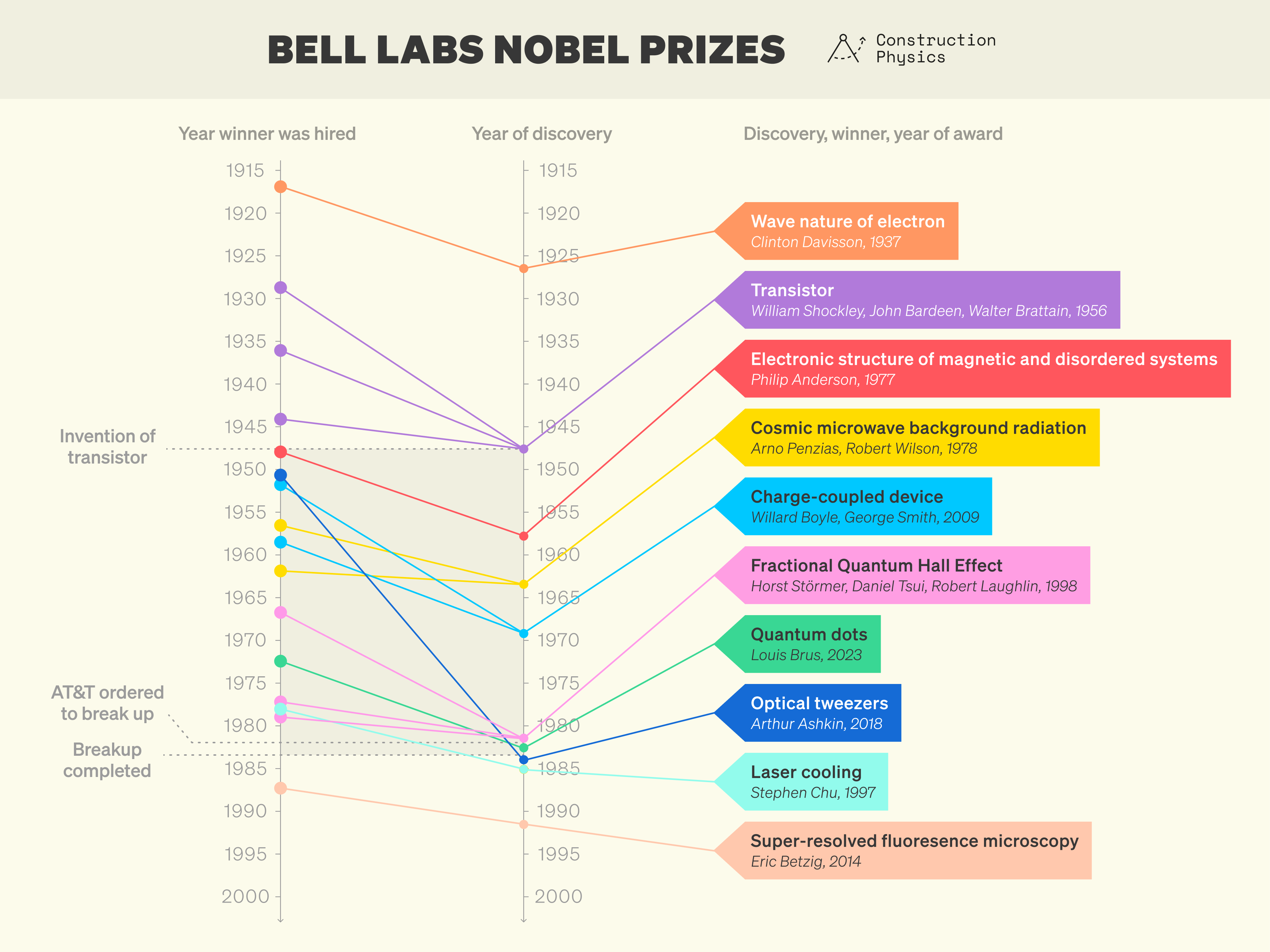
Bell Labs fostered a culture that encouraged interdisciplinary collaboration and allowed researchers the freedom to explore speculative projects without the pressures typical in academia.
In its efforts to constantly improve telephone service, Bell Labs would pursue a wide range of scientific investigations; its research division had departments ranging from physics and chemistry to metallurgy, mathematics, and even physiology and psychology. Though its mandate was to improve communications technology, there were innumerable possible ways that might be achieved. Invention, noted Harold Arnold, “is not to be scheduled or coerced” - who knew what fields of science might yield important, practical developments?
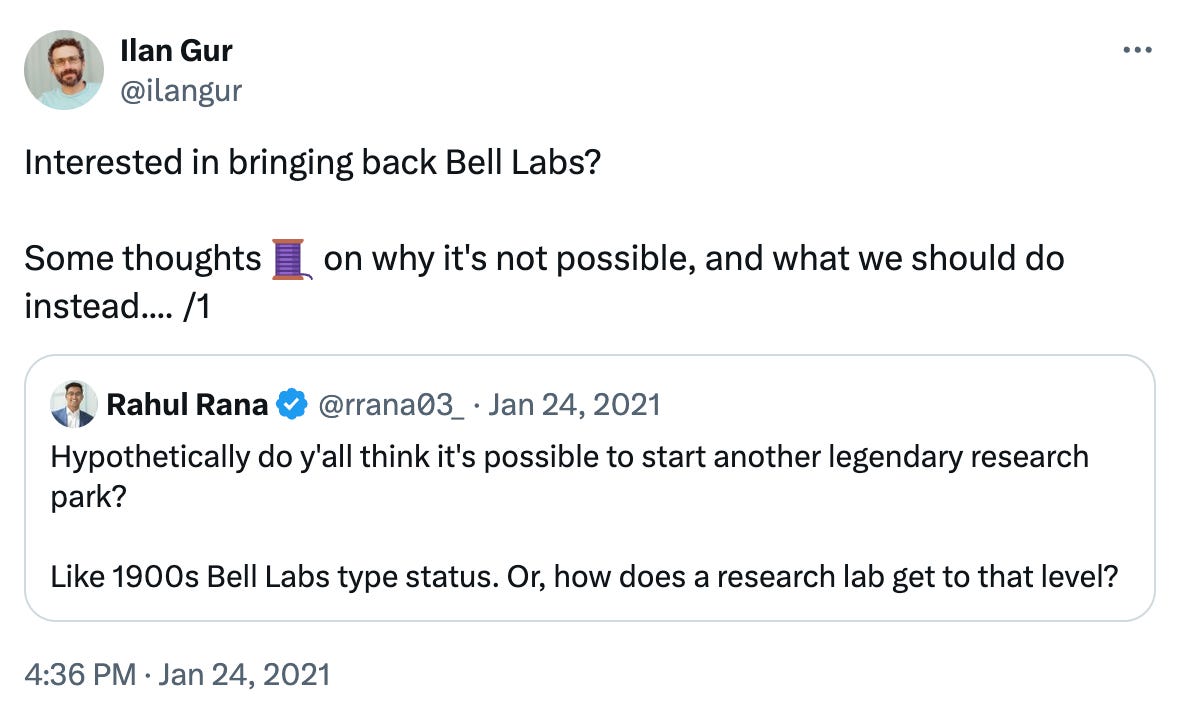
There’s a great thread by Ilan Gur on why another Bell Labs is not possible today, but what we can do instead.
5. It’s not all about the engineering
We talk so much about the technical aspects of engineering - and rightly so, these are the nuts and bolts that make designs efficient and safe - but we still don’t spend enough time covering off the soft skills.
Communication, empathy and willingness to learn/accept feedback are incredibly valuable in every profession, and yes this includes structural engineers.
Gregor Ojstersek discusses how these soft skills are often the solution to problems (or at the very least help) instead of our technical toolkit. It’s written from a software development standpoint and targeted at Tech Leads, but the principles are applicable to all structural engineers.
How often have you been in a heated meeting with a contractor wishing you (or someone in the room) had more diplomacy?
Gregor identifies three main soft skills you should make an effort to have some level of competence in.
The first is active listening, where your job is to focus on the speaker, stay silent (and embrace any awkward ones) and then reflect back what you think you heard them say.
For someone who has never studied communication styles before, this is a great first step. Like any skill, you need to practice, practice, practice. You’ve probably all heard of active listening, but how often do you do it?
I would actually recommend you go one step further here and integrate this into every aspect of your life. You’ll be amazed at the improvement you have in all of your relationships; from your significant other to the barista at the corner coffee shop.
Also check out the book Nonviolent Communication by Marshall Rosenberg if you want to learn more. Changed my life.
Back to the article though - the second key skill is to build strong relationships.
What does this look like? Over-communicating, following through on your actions, providing specific positive and negative feedback, touching base regularly with people in your team and going out of your way to help.
With working from home here to stay it’s still possible to build strong relationships, but we need to think a bit differently about how to do it. You need to be more intentional as you can’t just walk past someone and ask how they’re doing, or peek over and see what they’re working on and have a chat about it. You need to proactively communicate what you’re doing and reach out to your team.
Even if you’re not a manager or leader, you absolutely should be giving feedback to people in your team. Who is it better to hear from? Your boss who hasn’t worked directly with you for 6 months? Or another senior engineer you’ve been working with?
You know the answer.
Gregor hits the nail on the head with the key points to feedback (either positive or negative). It should be:
Timely
Specific
Clear
Honest
Continuous
If someone gives you feedback that isn’t specific (e.g. That was great!) then follow up and ask them for details: “What in particular did you like about it?”. Always be curious to learn more.